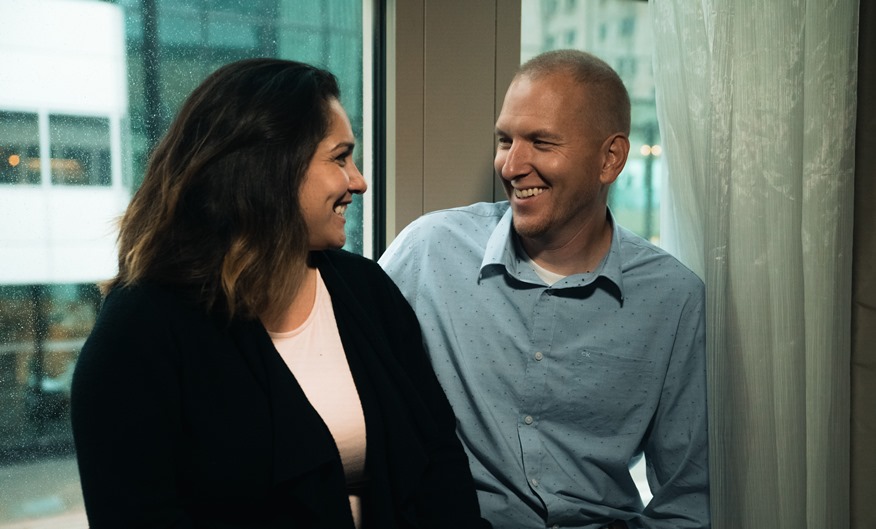
When Steve began experiencing flu-like symptoms, he and his wife Crystal didn’t think his condition was serious. His primary care physician and urgent care doctors thought he might have mononucleosis or tonsillitis, but Steve and Crystal knew these theories were unlikely since Steve had his tonsils removed as a child. When he realized antibiotics weren’t improving his symptoms, Steve decided to visit the emergency room. Crystal was at an after-school activity when she received a call from Steve to tell her he had leukemia.
A bone marrow biopsy revealed that Steve had a relatively rare blood cancer called acute myeloid leukemia (AML),2 a condition that includes symptoms such as fever, fatigue, night sweats, loss of appetite, weight loss and symptoms of anemia.3 This explained why Steve was feeling feverish and getting tired so quickly.
The couple decided that Steve would start treatment right away and, soon after, his scans were clear of leukemia cells. To decrease the chances of the cancer returning, they decided to pursue a hematopoietic stem cell transplant for Steve. Fortunately, his sister was a match and donated her stem cells.
After receiving successful treatment for his AML and quickly finding that his sister was a match for Steve’s stem cell transplant, Steve and Crystal were feeling optimistic that his health would improve. They were expecting their second child soon and were looking forward to the future. However, a follow-up visit with his doctor revealed cause for concern: abnormalities in his liver, caused by veno-occlusive disease (VOD). Stem cell transplantation is a frequent cause of VOD – a condition in which some of the veins in the liver become blocked, decreasing blood flow and putting the organ at risk for failure.4,5 His liver continued to deteriorate, to the point where his kidneys were starting to fail, too.
Feeling disheartened, the couple leaned on each other and Steve’s parents for support. They had been there with Steve and Crystal through every step of the cancer journey, accompanying them to his appointments, to the hospital and even during treatment discussions.
Steve was feeling extremely fatigued and incoherent as a result of his VOD, so Crystal and his parents discussed his options with his doctor and agreed on a treatment plan.
Fortunately, Steve’s condition started to improve, setting him on a path to recovery. While in the hospital, he was even able to watch Crystal give birth to their son through a livestream on a tablet.
Now in remission, Steve is grateful that his doctors detected his VOD early, which helped him and his family identify an appropriate treatment approach. Crystal feels lucky to have Steve by her side because she knows there was a period of time where his future with their family was not guaranteed. Two years later, the couple is enjoying life with their two young children and are happy to be feeling “normal again.”
U.S. residents can learn more at KnowVOD.com.
1Carreras E. Early complications after HSCT. In: Apperley J, Carreras E, Gluckman E, et al, eds. The EBMT Handbook. 6th ed. Paris, France: European School of Haematology; 2012:176-195.
2SEER Stat Facts: AML. https://seer.cancer.gov/statfacts/html/amyl.html Accessed October 14, 2019.
3American Cancer Society. Signs and Symptoms of Acute Myeloid Leukemia. https://www.cancer.org/cancer/acute-myeloid-leukemia/detection-diagnosis-staging/signs-symptoms.html Accessed October 14, 2019.
4National Cancer Institute. NCI Dictionary of Cancer Terms: Hepatic Veno-Occlusive Disease. https://www.cancer.gov/publications/dictionaries/cancer-terms/def/hepatic-veno-occlusive-disease Accessed October 14, 2019.
5Senzolo, M., Germani, G., Cholongitas, E., Burra, P., & Burroughs, A. K. (2007). Veno occlusive disease: update on clinical management. World journal of gastroenterology, 13(29), 3918–3924. doi:10.3748/wjg.v13.i29.3918.
الإبلاغ عن أثر جانبي
إذا كنت ترغب في الإبلاغ عن أثر جانبي مرتبط بالمنتجات الدوائية لشركة Jazz Pharmaceuticals، يُرجى إرسال بريد إلكتروني إلينا عبر الرابط التالي:
يُرجى تقديم أكبر قدر ممكن من المعلومات المتاحة.
تشمل المعلومات ذات الصلة ما يلي:
بتقديمك لتقريرك وتزويدنا ببيانات الاتصال الخاصة بك، فإنك تُقرّ وتوافق صراحةً على أنه يجوز لقسم السلامة الدوائية المحلي التواصل معك بغرض طلب معلومات إضافية أو توضيحات، إذا اعتُبر ذلك ضروريًا لتقييم التقرير ومتابعته.
يوضح إشعار الخصوصية الخاص بنا المتعلق باليقظة الدوائية والمعلومات الطبية وشكاوى المنتجات كيفية تعامل شركة Jazz Pharmaceuticals مع معالجة المعلومات الشخصية عند التعامل مع تقريرالأثر الجانبي الخاص بك، وهو متاح في مركز الخصوصية لدينا.
Report an Adverse Event
If you want to report a Adverse Event related to Jazz Pharmaceuticals medicinal products, then please send us an e-mail via this link:
Please provide as much available information as possible.
Relevant information includes:
By submitting your report and providing your contact details, you expressly acknowledge and agree that the local drug safety department may contact you for the purpose of requesting additional information or clarifications, should this be deemed necessary for the assessment and follow‑up of the report.
Our Privacy Notice for Pharmacovigilance, Medical Information and Product Complaints outlines how Jazz Pharmaceuticals handles the processing of personal information when dealing with your adverse event report and is available in our Privacy Center.
